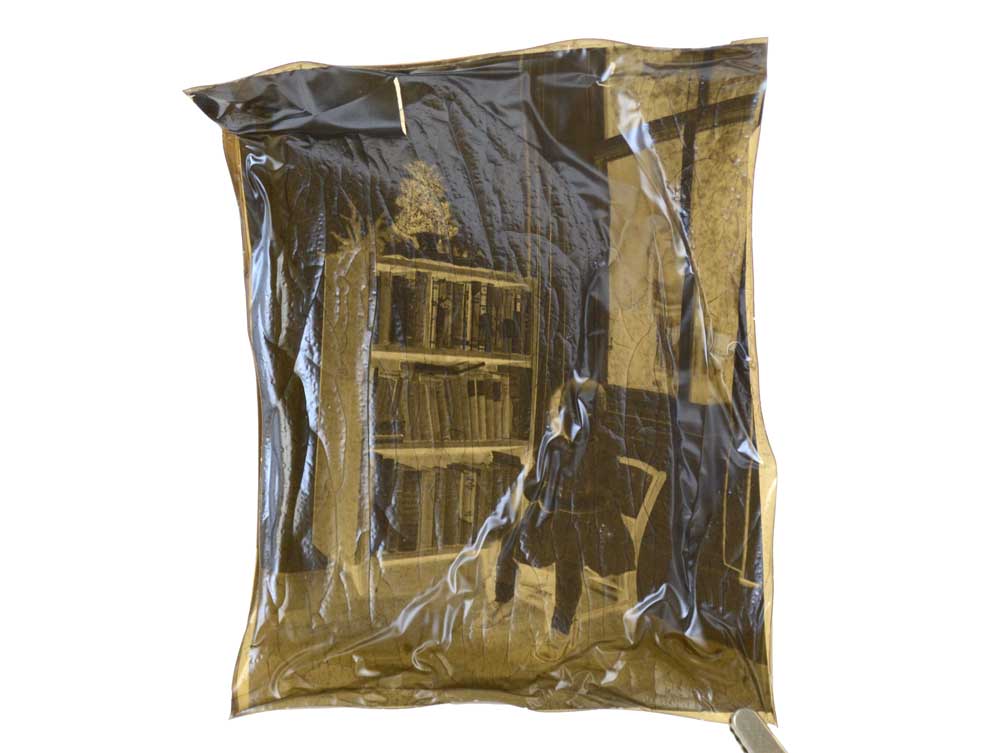
Negatives are one of the less stable materials in an archive. Two of the once dominant plastic supports used to make negatives (cellulose nitrate and cellulose acetate) are autocatalytic. Moisture, acids, and heat are catalysts for deterioration. Then, as the film begins to break down, it emits gases that accelerate its own decay. To slow down the deterioration of nitrate and acetate films you need to control its environment.
- Quick Tips
- Types of Negatives
- Glass Plates
- Cellulose Nitrate
- Cellulose Acetate
- Polyester
- Film Formats
- Storage Options
- Plastic-Free Storage Solutions
- Resources
TLDR: Some Quick Tips
- Hi-Res Scans – consider making hi-res scans of your negatives (DIY or hire a professional) before storing them. You’ll have a high-quality back-up, you can share the digital files, and you can make prints from them.
- Wear Gloves – when handling your negatives wear powder-free nitrile gloves or cotton gloves to protect the film and also to protect you. Sometimes wearing gloves can make handling difficult and even increase your risk of damaging your collection. We recommend wearing gloves but if you decide not to, make sure your hands are clean, dry, and free of any lotions, and only touch the negatives on the edges.
- Environment – cool – at or below 70 F / 21 C (the colder the better) and between 20 to 50% humidity (the closer to 20% the better but not below 20%) is desired. No attics or basements. Store out of direct light.
- Separation – when films are off-gassing they can harm other films in their vicinity. You should isolate the decomposing films, if possible.
- Boxes – use acid-free, lignin-free, and buffered boxes. Buffering will help neutralize acids in the environment. Do not use an airtight container (such as a plastic tote) because it can trap gasses.
- Enclosures – use acid-free Open End Envelopes or Negative File Folders for storing large format, medium format, and 35mm negatives
- Sleeves – when using sleeves use plastic that passed the PAT. Polyester Side Lock Film Sleeves or Interleaving Folders are the clearest and most inert. Polypropylene and HD Poly Envelopes are good, less expensive alternatives. Plastic sleeves protect the film during handling and when inserting into envelopes. If you want to avoid plastic (as recommended by some conservators) but still want to store multiple negatives in one envelope, you can make your own archival paper sleeves by folding paper in half.
- Kits – See our Film Storage Kits for all-in-one solutions.
Types of Negatives
There are many types of negatives and films. Still photography included glass plate negatives and paper negatives before plastic negatives dominated the field. Films for still photography and moving images come in color and black and white, and an array of sizes and formats.
Glass Plates

Negatives on glass supports include wet-plate and dry plate collodion in the 1800s which were then largely replaced by silver gelatin plates. There were also glass lantern slides that would fit into the 4 x 5 envelopes. Glass is fragile and it’s also heavy. Common glass plate sizes were 4 x 5, 5 x 7, and 8 x 10. When inserting a negative into an envelope, be careful not to scratch the emulsion when you slide it in. Using a plastic or paper folder can help avoid this.

How to Store Glass Plate Negatives
Store the plates vertically on their long sides. If your box isn’t full you will need to use something to keep the negatives upright. Options include Photo Box Spacers or crumpled up Archival Tissue.
- Open-End Envelopes
- acid-free, lignin-free paper will not harm negatives
- buffered to combat acids
- you can write important information on the envelopes (before inserting negative)
- paper allows gasses to escape and also absorbs acids
- stiffness of paper offers better support than plastic
- use with interleaving folders to avoid scratching your film
- Film Interleaving Folders
- easy open flap design; meant to be used with envelopes
- helps prevent scratching when inserting negs into envelopes
- protects neg from finger prints when handling
- polyester is very clear and inert
- Archival Paper Interleaving Folders (DIY)
- our Permalife Bond Paper is a good choice – it is buffered and a good weight
- an alternative to the plastic ones
- before inserting negative you can write info on it and store several together in one envelope
- Acid-free Foamboard
- to use as spacers between each envelope to cushion the plates
- very light, will not add noticeable weight
- Hinged Lid Boxes
- 02-003 can store 4 x 5 envelopes
- 02-005 and 02-004 will accommodate 5 x 7 envelopes
- 02-009 will accommodate 8 x 10 envelopes

Cellulose Nitrate
Cellulose nitrate was the first man-made polymer and was developed in the 1850s. In 1889 Kodak began marketing it as motion picture film and roll film. By 1950 it had been phased out and replaced by cellulose acetate films. Nitrate is highly flammable and once burning is very difficult to extinguish. A nitrate fire also generates toxic nitric acid fumes. If you have nitrate in your collection take precautions.

Cellulose Acetate
Cellulose acetate began replacing nitrate in the 1920s. It is called “safety film” because it is not flammable like nitrate film. As mentioned earlier, cellulose acetate is also autocatalytic. When it starts to break down it releases free acetic acid which is why it smells like vinegar and why this deterioration is called “vinegar syndrome.”


Small gauge movie films like 8mm, Super-8, and 16mm were marketed for home use and were not made on nitrate film stock. But, it’s likely you have nitrate still film in your collection if you have negatives pre-dating 1950. If your film says SAFETY along the edge then it is cellulose acetate. But if there’s no writing on the edge, no notch codes, and no odor, it can be very hard to tell the difference between cellulose nitrate and cellulose acetate.
“Environmental controls are essential for the preservation of film-based negatives. It is clear that typical ambient conditions (that is, approximately 40% RH and 70 F) are not adequate for the preservation of nitrate and acetate material. Of particular importance is the fact that once deterioration of a collection of negatives begins, it gains momentum rapidly, leading to the swift destruction of artifacts and increased health and safety risks.” – Paul Messier, 1993 from Preserving Your Collection of Film-Based Photographic Negatives

Polyester
Polyester was introduced as a film base in the 1950s and it is far superior when it comes to strength, longevity, and archivalness. It does not self-destruct and break down like nitrate and acetate do. Cellulose acetate and polyester are both currently being used as film bases. You can find instructions on how to make a cross-polarized viewer which may help you determine if your film is polyester or not.
Kodak’s brand name for its polyester film is ESTAR. From what I found online (from Reddit around 2024) regarding still film, some of their color films are on polyester and some are on acetate, while the B&W still films are on acetate. It is my understanding (and I may be wrong) that all of Kodak’s motion picture films are now made with a polyester base. Reach out to Kodak directly for the most accurate and up-to-date information.

The above image shows a variety of film formats on plastic supports. The 8 x 10 says “Kodak – Safety” on the edge so we know that it is acetate. The 4 x 5 and old medium format (large roll film negatives) don’t have any indication of what type of film they are but they are probably nitrate. The other three are from the early 2000s and they are likely acetate.
Film Formats
35mm and Medium Format
35mm film is usually cut into strips of between 4 and 6 frames. Old medium format negatives are usually found cut into individual frames. Photographers using medium format film now usually store them in strips. Our Film Storage Kit uses our Hinged Lid Box 02-003 in conjunction with Negative File Folders and Side Lock Film Sleeves.
If you have early medium format negs cut into single frames (and often in a variety of sizes) I’ll cover that later in this post. Or, you can go directly to How to Store Old Family Negatives, a post that focuses on this style negative.
A popular method of storing strips of film negatives is to use archival binder pages. This method is helpful for making contact prints. We offer a lot of binder pages for photos and one for 35mm mounted slides, but we do not carry binder pages for film. I believe this decision was made because you need to slide film strips into narrow channels and this increases the risk of scratching or even denting the film. High density polyethylene is the best choice for this style storage because it is a soft material and is static-free so it is very unlikely to scratch your negatives.

Large Format Film
Common large format sizes are 4 x 5, 5 x 7, and 8 x 10 but they can go up even larger. The 4 x 5 Film Storage Kit includes a hinged lid box (02-003), polyester film interleaving folders (30-101), and open-end envelopes (20-001). Or you could buy the box and envelopes a la carte if you prefer not to use the polyester sleeves.
Storage Options
Metal Edge Boxes
Our Metal Edge Boxes come in several colors and styles and we make them here in Rochester, NY. They are all acid-free, lignin-free, and buffered. The metal edges and high quality box board make these very sturdy so you can stack several of them safely.

I used our 8 x 10 1-1/2″ Drop Front Box (#01-011) to store these 8 x 10 negatives. The negatives are at least 75 years old and one of them (not pictured) started to warp after I had them stored in plastic sleeves for about two years. I decided to remove them from the sleeves and interleave them with Permalife Bond Paper. I am also separating out the warped negative from these better ones. I used the smallest Adhesive Back Vinyl Label Holder (37-695) to label the outside of the box.
- 1-1/2″ Drop Front Boxes – if you have 8 x 10 or larger negatives, you could store them flat inside one of these boxes. The drop front design makes it easy to remove items without damaging them.
- Hinged Lid Boxes – several of our hinged lid boxes are good for storing negatives upright.
- 02-003 can store 35mm, medium format, and 4 x 5 film inside paper enclosures (see Film Storage Kits)
- 02-005 and 02-004 will accommodate 5 x 7 open end envelopes

Enclosure & Sleeves
Our Enclosures and Sleeves are safe, archival quality that pass the PAT. On every product page there is a tab called Specifications where you can find that type of information. We have plastic sleeves and paper envelopes. They are often used together. Using a plastic sleeve that opens like a book reduces the risk of scratching your negative during insertion. It can then be safely slid into a paper envelope.
Many reputable resources recommend using polyester, polypropylene, and high density polyethylene for storing negatives, but, multiple conservators have advised against storing nitrate and acetate films in plastic. It’s fine to store polyester in plastic sleeves, but you are more likely to find acetate and nitrate film in your collection. It’s okay to store newer acetate negatives in plastic.
According to photo conservator Gawain Weaver, if stored in a climate-controlled home, acetate negatives from the 1990s are ok to store in plastic. The line between ok to store in plastic or not falls sometime in the 1970s or 1980s. Storing in plastic is okay in the short and medium term for the newer acetate. And because cold storage basically slows time down to almost a standstill, if they are in cold storage then effectively they stay “newer” for a very, very long time.
I came across this interesting theory that seems to back up the experts’ pro-paper stance (paper is breathable and can absorb off-gassing, whereas plastic cannot). Apparently, acetate audio tapes have not suffered from vinegar syndrome to the same extent as motion picture films. The author notes that audio tapes were normally stored in cardboard boxes which absorbed off-gassing (and allowed gasses to escape), while sealed film cans trapped the harmful gasses with the film.
For the record, many, many photographers store their film in plastic sleeves or pages and have done so for many decades. Archivists are in charge of items that they want to preserve for as long as possible within their budget constraints. We are not telling you not to use plastic sleeves. We are giving you as much relevant information on the topic as we can find so that you can make an informed decision. If you would prefer to use paper only, I will discuss a DIY solution later in this article.

Paper Envelopes
- Open-End Envelopes – acid-free, lignin-free, and buffered. Sealed on three sides, open on short edge, no flap, no notch. These feature two side seams, as recommended for archival storage. You should still insert your negatives emulsion side facing away from seams. We have them for 4 x 5, 5 x 7, and 8 x 10 negatives. If you have single frame medium format negs you could store them in the 4 x 5 envelopes. You can store multiple negatives in one envelope if using paper or plastic interleaving folders.
- Negative File Folders – acid-free, lignin-free, and buffered. Alternating tabs for labeling, sorting, and accessing. Can store multiple negative strips – 35mm or medium format – in one folder.
- Archival Photo Envelopes – acid-free, lignin-free, but not buffered. The envelope consists of two pockets, one for storing your prints and one for the corresponding negatives, like old photo lab envelopes. Can hold multiple strips of four 35mm frames and possibly smaller early medium format negs.

Plastic Sleeves
- Polyester Side Lock Film Sleeves
- for 35mm and medium format strips and 4 x 5, 5 x 7, and 8 x 10 sheets (and larger, if needed)
- polyester is extremely clear and inert and has a natural static charge
- Polyester Film Interleaving Folders
- for 4 x 5 and 5 x 7 negatives
- sealed on one short end only so these need to be used with Open-End Envelopes
- insert them open end first
- Polypropylene Side Lock Film Sleeves
- for 35mm strips
- very clear but less so than polyester, also less stiff
- less static than polyester
- less expensive than polyester
- High Density Polyethylene Envelopes
- for 4 x 5, 5 x 7, 6-1/2 x 8-1/2, 8 x 10, and 11 x 14
- semi-transparent so you can see the image inside without removing it
- like all the plastics, not good for writing on
- you can add a piece of White Card Stock as a support within the envelope (which you could also notate on the back)
- soft, static-free material reduces risk of scratching
- less expensive than archival envelopes

Plastic-Free Film Storage Solutions

Once I learned that some conservators cautioned against plastic enclosures for film I decided to figure out a suitable alternative. First, I asked what is the function of the plastic sleeve?
- during handling, viewing, and inspection it provides some rigidity and support, and protects from fingerprints
- it protects the negatives from scratches while inserting into envelopes
- it acts as interleaving between negative strips that are stored together in the same envelope (such as a “roll” of film which would have four to six strips)
The fingerprint problem can be solved by wearing gloves when handling your negatives. Make archival paper folders as an alternative to the plastic folders. They will act as interleaving and protect from scratches. It’s an easy DIY solution.
One drawback to using paper folders is the negatives are not secure in the folders like they are in the side lock sleeves. Even the polyester Interleaving Folders have a static charge that helps keep the negative in place. With Paper folders you must be careful whenever you need to handle them. But if the negatives are not an “active” collection (ie: being accessed and used often), but are just being preserved safely, this should not be an issue.
4 x 5 / Medium Format Single Frames
I created simple archival paper folders to be used in conjunction with our 4 x 5 Open-End Envelopes. You can order a package of 8 x 10 paper, and ask for it to be cut in half length-wise to create 2 stacks of 4 x 10 sheets. Each sheet can be then be folded in half to make a 4 x 5 folder. This acts as interleaving to separate multiple negatives in one open-end envelope.


Depending on the size of your medium format negatives, you could also order 4 x 6 Permalife Paper (132-46) and fold it in half to create a 3 x 4 folder for smaller medium format negatives. You could use pencil to label each folder along the edge (before inserting negative) so you know which negative is which without having to open the folder and look at them.
I tested several of our papers and my favorite for this project was the Permalife Bond Paper. While our Archival Tissue and Archival Thin Paper – Unbuffered would also work, they are both very thin. The thinness means they take up less space and are less expensive, but they are less rigid (and therefore less supportive) and more finicky to work with. Order a Board & Paper Sample Pack if you’d like to compare our paper options before you decide.
I will show examples of the Thin Paper and the Permalife. We now offer the Permalife in pre-cut sizes for making your own paper folders (4 x 6, 4 x 10, 5-1/2 x 10). Do not use Glassine Interleaving with negatives (or gelatin silver prints) because in certain conditions it runs the risk of sticking to the emulsion).
35mm and Medium Format Film Strips
Folder Method
The simplest method is to do what I did above but with long folders to be used with our Negative File Folders. For 35mm strips you’d order the 8 x 10 paper cut in half lengthwise again, but you will fold it on the long edge. This 4 x 10 paper folded in half lengthwise results in a 2 x 10 folder. Our negative file folders are 10″ long and can hold a roll of 36 exposures cut into strips of 6 frames each.

Side Note: Don’t Store Your Negatives Like This!
I had an old Kodak Printing Paper box overstuffed with negatives stored in my attic. Of course this was a very bad storage option. Now that I work here I’m making better choices. In the above photo you might notice an area of the plastic that looks puckered. That’s because it was stuck to my negative in that spot. Luckily it was stuck to the base and not the emulsion and it separated without damaging the negative.


Now Back to More Archival Storage Options

Notes on the above image: Top: I wrote the negative numbers in the upper right corner on the paper folders (Thin Paper). Middle: I inserted the seven folders with negatives (this roll had 38 exposures on it) into the Negative File Folder which I labeled with location and year. There’s plenty of room to write more extensive notes. Bottom: shows the negatives nestled in their new home – the Negative File Folder. I inserted the folders with the open side facing down for added protection but you have to remember to flip the File Folder upside down before removing them if you do this! They’re ready to go into an archival metal edge box and be put on a closet shelf in my climate-controlled living space.
For strips of medium format film you can request the 8 x 10 pack of Thin Paper be cut down to 5-1/2 x 10 so that it can be folded lengthwise to be a 2-1/4 x 10 folder. If you opt to use Permalife those come in pre-cut sizes.


Resources
As I researched this post I came across opinions and advice that sometimes varied from source to source. We always try to give you the best advice, but we are not trained conservators. If you’d like to consult a conservator here is a useful tool for finding them.
DIY Paper Folder Sizes
All of these paper sizes can be ordered on the Permalife Bond Paper page. If you opt for another paper (any except Glassine!) you may have to order a size up and have it cut down.

Here’s a list of sources consulted for this post.
- Identifying and Handling Nitrate Film
- History of Film Timeline
- A Short Guide to Film Base Photographic Materials
- Caring for Film
- Care of Plastic Film-based Negative Collections
- IPI Storage Guide for Acetate Film
- Envelopes and Sleeves for Films and Prints
- Film-Based Negatives and Positives
- How to Preserve Photographs and Negatives
- Guidelines for Care & Identification of Film-Base Photographic Materials
- The Acetate Negative Survey (Horvath)
- Gawain Weaver Art Conservation
