This post focuses on storing and preserving individual medium format negatives from the early and mid-20th century roll film cameras. Many family collections have these types of negatives that were returned to the customer cut into single frames. For the in-depth, comprehensive article on how to store negatives please visit How to Store and Preserve Negatives. It covers different formats (35mm strips, medium and large formats), film bases (glass, nitrate, acetate, and polyester), storage environment, and more.
- Storing and Preserving Negatives
- Getting Started
- Storage Materials
- Simple Option
- Do-It-Yourself Folders
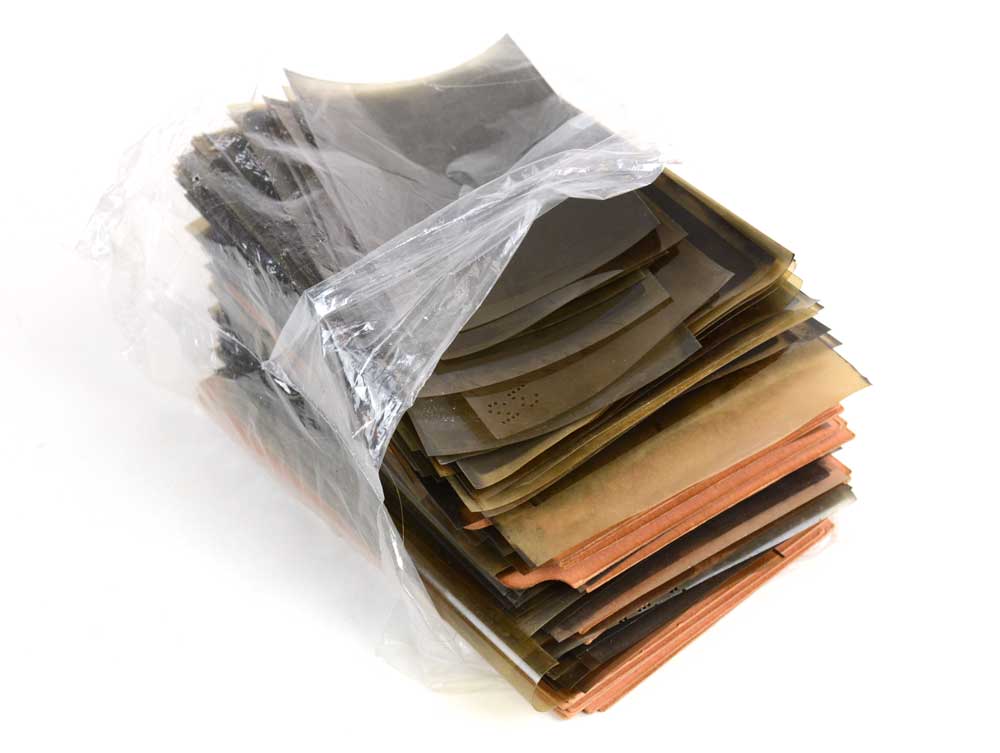
Above is an example of how one might inherit the early family negatives. Yes, it’s a mess and not archival, but with some time and effort you can sort, label, and store these properly. Even doing a little work would help – removing the negs from the baggie, removing the orange paper dividers, and placing the pile into an archival box.
Here’s a short, fun video about the rise of snapshot photography via Kodak cameras and roll films. In the first several decades of the 20th century most amateur photographers were shooting roll film (similar to modern medium format film – so called because it is larger than 35mm and smaller than large format – 4 x 5 and up). There were different sizes of roll film so your collection might have negatives of varying dimensions.

Storing and Preserving Negatives
If you have these types of negatives in your collection we encourage you to preserve them, because nothing compares to the original format. We recommend that you make hi-res scans as back-ups and to share with family members. You can also make prints and enlargements directly from your negatives or from your digital files.
When dealing with early 20th century negatives there’s a fair chance they are cellulose nitrate film, which is extremely flammable, so take precautions. Introduced around 1920, cellulose acetate gradually replaced nitrate over the next thirty years until nitrate was completely phased out. If you see the word “safety” on your film that indicates that it is acetate. But a lot of acetate isn’t labeled and it’s very hard to tell the difference. If it smells like vinegar then it is acetate (and it is breaking down and should be separated, if possible).
Both nitrate and acetate are autocatalytic which means that once the material (plastic) begins to break down (initiated by heat and humidity), it releases gasses that increase its own deterioration.

Environment
Store you negatives at or below 70 F / 21 C (the colder the better) and between 20 to 50% humidity (the closer to 20% the better but not below 20%). No attics or basements. Store out of direct light.
Getting Started
I will use that pile of negatives in the plastic baggie as a sample project. First, get some powder-free nitrile gloves to protect both the negatives and yourself. If mold is a concern or you are are sensitive to it, wear an N95 mask. Set up a clean work area away from food, beverages, and pets.

Inspect your negatives. After taking a quick look at some of these negatives I see that there is dead or inactive mold or mildew (it’s not wet or slimy) on them. I used the Pec-12 Film and Photo Cleaner and Pec Pads to clean the negatives. Pec-12 should be used in a well-ventilated area.

It might be helpful to keep the negatives in order if you can, as someone at some point might have organized them. While a light box would come in handy during sorting, if you don’t have one you can just hold the negatives up to a bright light.


This stack has a variety of negative sizes. Next I will go over how to store them with archival preservation supplies.
Storage Materials
You will need an archival box and envelopes to store your negatives. We recommend acid-free, lignin-free supplies for long-term storage of negatives and other family archival materials like documents and photographs. Buffered board and paper add acid-scavenging properties to these supplies. All of our boxes and most of our envelopes are buffered with calcium carbonate.
Three Main Components
- Archival Paper Folder (optional)
- Archival Envelope
- Archival Box
Some people use plastic enclosures or sleeves for storing negatives but based on information from several experts I would avoid plastic enclosures for negatives pre-dating 1960. Again, for more info on this see the comprehensive negative storage blog post mentioned earlier.
Simple Option
A simple option would be to order 4 x 5 Open End Envelopes #20-001 and Hinged Lid Box #02-503. These items are acid-free, lignin-free, and buffered. You would write identifying information about each negative on the envelope first. Then you would carefully insert one negative per envelope, taking care not to scratch the negative. Next put the envelopes into the archival box. If the box isn’t full, use a Photo Box Spacer to keep the negatives upright.

If you don’t have a lot of negatives you could opt for the Hinged Lid Box 02-506. It’s an unusual hinged lid box because it’s the only one that has a drop front panel and it is fairly small (5-1/8 x 5-7/8 x 3” H). Our 4 x 5 open end envelopes can be stored flat inside of this box.

Option with DIY Folders


For the larger negatives in the bunch I used 4 x 10″ Permalife Bond Paper folded in half to create 4 x 5″ paper folders. I could label each folder (when empty) using pencil and then store about four negatives inside one 4 x 5 Open End Envelope. So if you have a large collection this is one way to save some money.

Folders for Smaller Sizes
You could put the smaller sizes into the 4 x 5 folders or you could opt for the following. I folded 4 x 6 Permalife in half to create 3 x 4 folders for the smaller negatives. When folding paper a bone folder isn’t necessary but it does make it easier and creates a nice sharp fold.
Archivists recommend using pencil in an archive. Pens and archives don’t mix. You can erase pencil if you make a mistake. But if you do want to use a pen to label your boxes or outer envelopes, make sure you use an archival pen that passed the PAT.
Since the 3 x 4 folders are fairly small I made another envelope to hold them together inside the 4 x 5 Open End Envelope. For the inner envelope I used 5 x 7″ White Card Stock (79-57) folded in half to be 3-1/2 x 5. I used about 2 inches of Filmoplast P 90 to tape one edge closed which created an L-shaped folder. It could hold about seven negatives in folders.


We hope you have found this blog to be helpful. Feel free to contact us if you have any questions about archival storage.
