Many family collections include cabinet cards, cartes-de-visite, and other types of mounted photos. This post will help you safely store these cabinet card photos and other images with preservation in mind.
Related Video: How to Store Antique Cabinet Cards, Cartes-de-Visite, and Other Mounted Photos
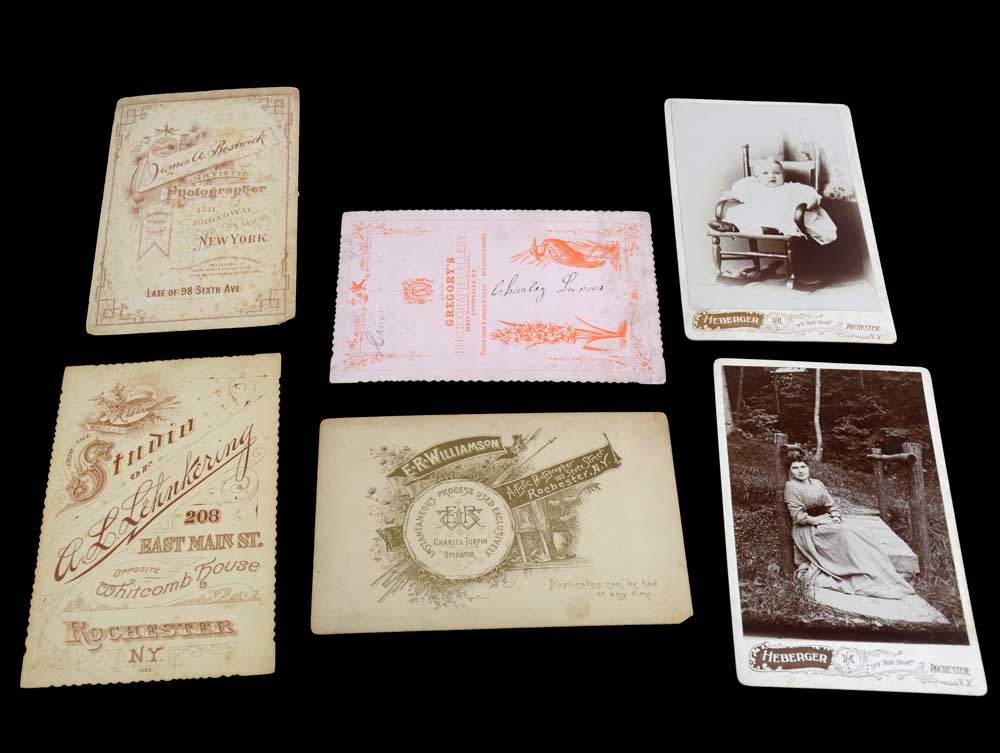
The carte-de-visite (CDV) and cabinet card were two very popular photographic styles in the mid to late 1800s. Created by professional studios, they both featured a photograph, often albumen, mounted to a heavier piece of board. The front and back of the mount, especially on cabinet cards, often had information printed on it, such as the studio name and location. The mounts came in different colors but are often white or cream.
Even though these formats died out by the turn of the century, some photographers continued to mount photos onto cardboard mounts. Certain photo processes were on paper that was likely to curl when dried, so they were mounted on a board. Even in the late 20th century photographers were mounting prints to backing boards. This has fallen out of favor because it is generally not considered an archival option.

Mounted Photographs in a Range of Styles and Sizes
In the photo above, the two cabinet cards (middle bottom) feature the studio name and city stamped on the bottom edge. There are six carte-de-visite portraits and the rest are examples of the variety of shapes, sizes, and colors of mounted photos. There are outdoor snapshots and indoor studio portraits. Most of them have faded and yellowed over the past hundred years or more.
These mounting boards are a part of the object. They contain acids and lignins, and like so many items, if you want to preserve them and prolong their life you will need to store them properly. Before you store them you should create hi-res digital files by scanning them or hiring someone to do it.
Archival Storage
Once they are scanned and ready to be stored, you have several good options. Cartes-de-visite were the same size as calling cards and measured about 2-1/2 x 4-1/4″, while cabinet cards usually measure 4-1/4 x 6-1/2″. Other mounted photos will vary greatly in size from very small to oversized.
Fighting Acids with Buffered Materials
These types of photos are very old and inherently acidic, so storing them in a buffered box is a good choice. Adding calcium carbonate as a buffering agent to paper helps the product scavenge acids in the environment. But certain items should not be stored long-term in direct contact with buffered paper and one of those is albumen photographs.
Since many CDVs and cabinet cards are albumen photos, you should have a barrier between each photo and also the photo and the buffered storage material. Our Archival Thin Paper – Unbuffered would be good for interleaving albumen photos, especially larger photos that you plan to store flat inside a 1-1/2″ Drop Front Box.
Archival Sleeves and Bags

Another method of protecting your old photos would be to use archival plastic sleeves. The polyethylene, polypropylene, and polyester sleeves and bags that we carry all pass the PAT (Photographic Activity Test). These include Polyethylene Bags, HD Poly Envelopes, Crystal Clear Bags, 3-Sided Sleeves, and Side Loading Print Sleeves.
The above mounted photo of the baby measures 6 x 8 inches. I used an 8 x 10 polypropylene 3-Sided Sleeve and folded over the excess bag. I did not use a backing board so the handwriting on the back remains visible.

Backing Boards
The photo above on the right has extensive damage to the mounting board so I recommend using a backing board. I used an Archival Bag Stiffener for that one because it is a heavier board and more rigid. I also used a Crystal Clear Bag with the resealable flap.
For the photo of the boy, I used a card stock backing board and a 3-sided sleeve which is open on one end. The backing board can be used to record information about the image using a #2 pencil.

You could store these with other larger photos in an 8 x 10 Drop Front Box as the above photo illustrates. If you are storing a mixed collection of photos inside a large Create-a-Kit and only have a few over-sized ones, you could put these inside the envelope that comes with the Pre-made Large Kit (#60-2700-L) and rests on top of the caddies.
Storing CDVs and Small Mounted Photos
Polyester Side Loading Sleeves are good for negatives and photographs, but are not always the best choice for mounted photos because these sleeves have a smaller tolerance that doesn’t work well with the thickness of the mounting board. But, they are a good option for storing cartes-de-visite photos.

CDVs are 2-1/2 x 4-1/4, which fit into 2-7/8 x 4-5/8 polyester Side Loading Print Sleeves (#32-102). You can use the sleeves alone or add a piece of card stock as a backing board. I recommend black card stock for this purpose, as it is thinner than our white card stock. You would order 4 x 6 card stock and request that we cut it down to 2-3/4 x 4-1/2.
Without card stock you can see the studio mark and any writing added to the backs of the CDVs. Even though the sleeves are open on the top and bottom the photos will not fall out. The stiffness and natural static charge of the polyester holds them in place.

There are a few box options for safely storing CDVs. Our Create-a-Kits come in two pre-made sizes or you can mix and match to build your own kit. The small 5 x 7 print caddy works well for holding CDVs, as seen above.

Save with Polyethylene
A less expensive alternative to polyester would be to get the 3-1/2 x 5-1/2 polyethylene bags (#35-201). This is our smallest size poly bag and it is the only one that doesn’t have a flap. If you want card stock we have inserts for binder pages that are 3-1/2 x 5 (#52-013-P). Or, order 4 x 6 card stock and ask us to cut it to fit the bags. But if you use these poly bags for your CDVs they won’t fit into the above box.
Storing Smaller Photos

Another option for small photos is the Small Collectibles Hinged Lid Box that is 2-1/8 x 3-3/4 x 2-5/8” H. CDVs are too big to fit inside this box but many other small vintage photos will fit. I have a small stack of about ten of these little square mounts with circular images of children. I could order 4 x 6 Archival Thin Paper – Unbuffered and request it be cut to 3-1/2 x 5. Fold in half lengthwise to get a folder that is 2-1/2 x 3-1/2.
Storing Cabinet Cards and Similar Sizes
Cabinet cards are 4-1/4 x 6-1/2 but they will fit into 4 x 6 Poly Bags. These bags are 4-1/2 x 6-1/4 plus a one inch flap. The image side will be completely covered but a small bit of the back of the card will not. This is fine because you are trying to protect the images from each other.


The above box (04-056) and caddies (02-557-S) can be ordered on the Create-a-Kit page. This configuration features two packs of small 5 x 7 caddies. The box is 5-3/4″ deep so any mounted photos less than 5-3/4 x 7 will fit.

For odd sizes that you want to store in the caddy but that don’t fit into standard sleeves, you can intersperse them between the sleeved images. Another option would be to get a package of 5 x 7 Archive Envelopes which will also fit into these caddies. These envelopes are unbuffered so they are safe for any photos, including albumen.

Storing Albums with Mounted Photos

Along with the craze for CDVs and cabinet cards came fancy photo albums designed to hold them. The covers were usually embossed leather or velvet and the pages created a decorative frame around each image. The above album was designed to hold CDVs. People often wrote identification info in these albums.
We usually recommend keeping the album intact (unlike more modern magnetic photo albums). You can still take steps to preserve this object and its photos. Use Archival Thin Paper – Unbuffered as an interleaving paper between pages. Measure the page size and order the next size up and ask for it to be cut down to the size you need.

You might find items tucked inside the album. These should be removed and properly stored. You might also find some tintypes mixed in!

You could keep the lock of hair where you found it if you put it between two pieces of unbuffered paper. Or put it in a Crystal Clear Bag. If using a card stock backing add a piece of unbuffered paper between the hair (which is animal-based) and the card stock (which is buffered).

We found this family record document folded up inside the album as well. To preserve it I would put it unfolded into an archival sleeve with a backing board. See How to Store Old Letters and Documents for more on this topic.

Since the album has a leather cover you need to put a layer of unbuffered paper around it or put it in a poly bag. In this case we used the Small Book Storage Kit (04-BOOK-SM) which comes with two polyethylene bags. We added Archival Tissue to fill the extra space around the book.
Where to Store your Acid-Free Boxes
Once you have your photos stored with safe, archival materials, it’s time to put the boxes in a safe location. Climate control is a major factor in preservation. Room temperature (70 F) or lower with a relative humidity around 50% is desired. Find a closet shelf or bookshelf that is out of direct sunlight to store your boxes. A second floor is great. If storing on a first floor store the boxes above a potential floodline.
Contact us if you have questions about your archiving project and we will do our best to help!
