Most people like having their books on display on bookshelves. But for rare, valuable, or special books you can extend the life of a book by storing it in an archival box in a climate-controlled environment. We’ll take a look at how to store old books to preserve them.
Initial Assessment
- What is the cover made of? The answer is usually either cloth or leather. If it is leather (animal-based), you will need to provide a protective layer between the leather and the buffered box (all of our boxes are buffered to fight acids).
- Are there images or pages in the book that you want to add interleaving for?
- Are there extraneous objects (things someone left in the book that do not belong)?
- What is the condition and will you take it to a conservator?
- What are the dimensions? Measure the width, length, and depth.
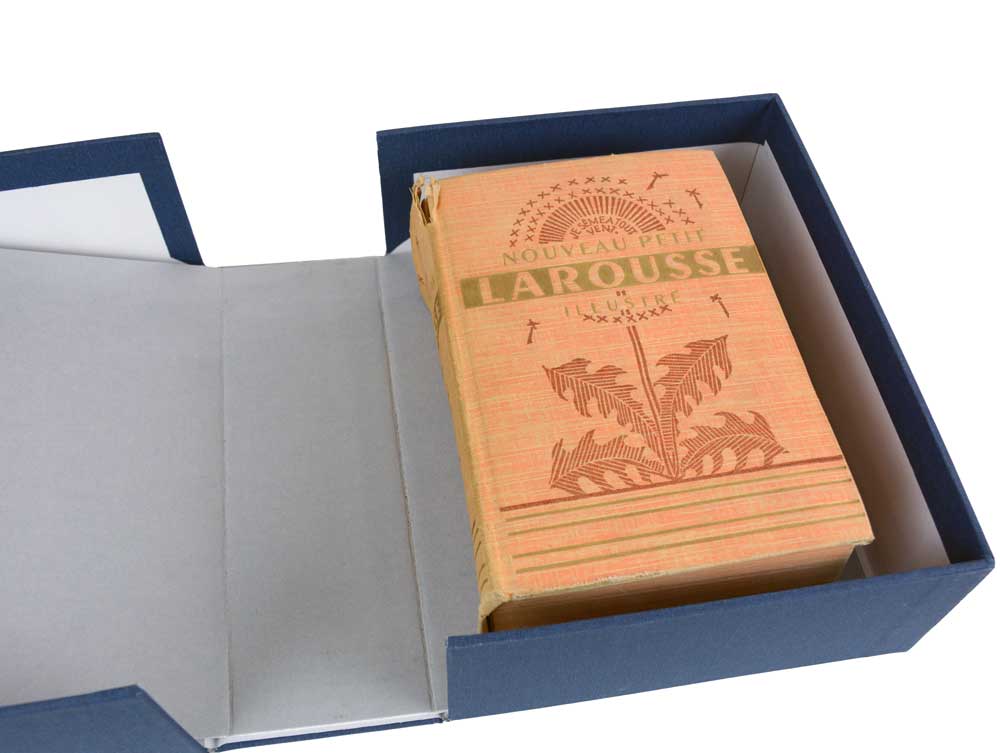
Example One: Nouveau Petit Larousse Illustre
I’m using a vintage French dictionary as an example of how to store your old books. The cover is cloth so I could put the book into an archival box without additional materials. There are color plates that I could interleave with one of our archival papers, if desired. The top of the spine is damaged but I will store it as is. It measures 5-1/4 x 7-3/4 x 3 inches deep.

If you just want to buy an archival box to store it in, here’s a PDF chart of all of our box sizes. The best Metal Edge Box for this size book would be the 6-1/2 x 9-1/2 x 3″ (04-096) Full Top Box. This box is part of the Small Book Storage Kit which also comes with two Polyethylene Bags and a Label for the box.

Our smallest Rare Book Box with Cradle is another good option for this dictionary. The interior dimensions are 7-1/4 x 9-1/4 x 3-1/4″ high. For a thick book like this, the built-in cradle is especially useful for supporting the spine when you want to look at your book.

While this book fits well inside this box, you always have the option of using Archival Tissue to create cushioning inside your boxes if you are worried about items sliding around. In this case, since the cover is book cloth, I used sheets of 8-1/2 x 11 Buffered Tissue.

Example Two: 19th Century Photo Album
Elaborate photo albums in the 19th century were designed to hold popular formats such as cabinet cards (pictured here), cartes-de-visite, and tintypes. The covers were ornately decorated and usually made of leather or velvet. This album has a leather cover, so during long-term storage inside a buffered box it will need a barrier.
This album is about 9 x 11 x 3 so it will fit into our Medium Book Storage Kit with a 10-1/2 x 12-1/2 x 5 full top box and two poly bags. The medium-sized Rare Book Box with Cradle (10-1/4 x 12-1/4 x 4-1/4) would also be a good choice for this album.
The Benefits of a Book Cradle
The spines on both the dictionary and the album are damaged. Book spines are a vulnerable part of a book because they experience so much moving and flexing. The Larousse dictionary has damage on the top of the spine which was likely caused by being pulled off of a bookshelf by the top edge of the spine. You should always remove a book from a shelf by holding the sides of the book.

Using a book cradle will help lessen the stress on a book’s binding. If you don’t have a book cradle you can use two clean rolled up hand towels as supports.
Leather Book Covers
As mentioned, animal-based products such as leather should not be stored long-term in contact with buffered board. But being stored in a buffered box with the added acid-scavenging qualities is a good idea.
For a barrier you can put the album into an archival Polyethylene Bag. Our bags feature a flap that you can just fold over, you don’t need to tape it closed. It’s good to have some airflow. If you need to calculate what size poly bag you will need for your book we have a handy formula you can use.

An alternative to the poly bag is to wrap the album in an unbuffered archival paper.


Caring for the Inside of Your Books
I mentioned extraneous objects that you may find in books. Pressed leaves and flowers are commonly found in old books and if you find any you should remove them. If you feel like the findings are part of the object’s history and want to save them just be sure to separate them into their own sleeve or envelope. Polypropylene 3-Side Sleeves might be a good option for this.
If you want to use bookmarks in your books, use Bookmarks made with archival paper. And if you plan to write any notes on them, use a pencil.

Interleaving
Use an archival paper as interleaving between pages with photographs or images. Below is a good example of an image transferring to the facing page. Using an interleaving paper for book illustrations can protect the image and the facing page. Buffered archival tissue makes an excellent interleaving because it is thin and won’t add much bulk to your book.
For the leather photo album above I would use Archival Thin Paper – Unbuffered as interleaving. The reason is that some of the photos might be albumen prints and albumen, cyanotypes (blueprints), and dye transfer prints are recommended to be stored with unbuffered interleaving. For the majority of photographic processes buffered paper is recommended.

Storage Location
As we say in every blog post, store your archival boxes in a second floor closet or bookshelf. If stored on the ground floor, make sure it’s not underneath a bathroom (in case you ever have a leak or burst pipe). Also, store it off the ground to protect it from potential flood damage.
Please contact us if you have questions about archival storage or our products. We are happy to help!
Related Posts
Archival Storage for Scrapbooks and Vintage Photo Albums
