The Canadian Conservation Institute created a list of ten primary threats to collections objects and called it Agents of Deterioration. It’s written for archives and museums but has invaluable, in-depth information for anyone trying to preserve items in their care, such as a family archive. If you want very detailed, scientific breakdown of these agents visit their site.
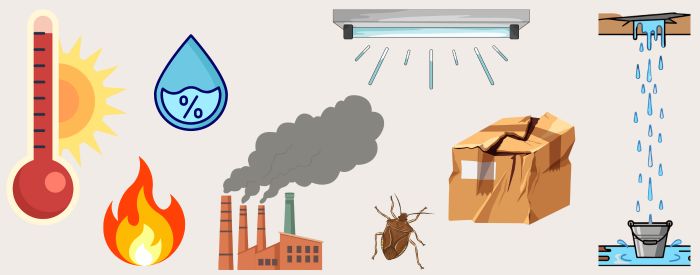
This post will discuss these Agents of Deterioration that can threaten collections in home archives, and how to combat them. These include:
- Light
- Incorrect Temperature
- Incorrect Relative Humidity
- Physical Forces
- Water
- Fire
- Pests
- Pollutants
- Dissociation
- Thieves and Vandals
1. Light
Sunlight is very detrimental to objects. Curtains usually show fading along the edges that get daily exposure to sunlight.
Newspaper will yellow more rapidly when left in sunlight. Sunlight accelerates the breakdown from acids and lignins in the paper (it’s meant to be disposable so it is printed on very cheap paper).
Ultraviolet (UV) and infrared are invisible bands of radiation on opposite ends of the visible light spectrum. Many household light bulbs do not emit UV radiation but sunlight and fluorescent bulbs do.
Many homes let in significant amounts of natural light. Windows may have a coating to block some UVB rays but not UVA. Therefore, sunlight and fluorescent bulbs are a threat to your collections.

What You Can Do
- For things you want to preserve, don’t store them where they are exposed to light. Even if your objects are in a box, you don’t want them exposed to sunlight on a regular basis. Infrared radiation heats the surface of objects (which leads to Incorrect Temperature damage).
- For framed items on display, use UV-filtering acrylic and hang them out of direct sunlight. See the blog post about Light Damage for more information.
2. Incorrect Temperature
Incorrect temperature usually means a temperature that is too high, which has the potential to damage various artifacts and shorten their lifespans. Low temperatures are usually better for many items such as photos, negatives, and paper. High temperatures are detrimental to most things. Heat accelerates deterioration in photographs.

What You Can Do
- Store your collections at room temperature (70°F / 21°C) or below (cooler is better!)
- Do not store collections in sunlight, near heaters, or directly above or near fireplaces
- Read more about the importance of temperature control for storing 20th century artifacts
3. Incorrect Relative Humidity
Different items have different needs when it comes to ideal relative humidity. Problems arising from high relative humidity are the formation of molds, corrosion, and mechanical damage.

What You Can Do
- Keep the relative humidity in your home between 35 – 50%. In some climates this will require air conditioning or a dehumidifier. Get some hygrometers to monitor humidity levels.
- Use reusable desiccants inside your archival storage boxes. Desiccants have silica beads that absorb moisture from the air. Once the beads are saturated you need to remove the moisture to “recharge” it. Remember to check them periodically and recharge as needed.
4. Physical Forces
Physical forces such as impact, shock, and vibration can damage items in your collection. An earthquake is an extreme example. In a home archive the most likely reason for damaged items from physical forces are mishandling, poor storage conditions, and accidents. One example might be storing a large heavy box on a high shelf and dropping the box when trying to get it down.

What You Can Do
- Store your items in acid-free, lignin-free, buffered archival boxes. Use archival tissue to cushion and protect objects within the box. When storing multiple items together, prevent them from damaging each other by using tissue, poly bags, and boxes with caddies or compartments.
- Use strong metal edge boxes that will not collapse from the weight of other boxes when stacked (only stack a few high)
- Designate a clean, food-free, beverage-free, and pet-free area for working on your archiving projects. Handle your items with care.
- Consider the storage location for your archival boxes – make sure the shelf is deep enough for the box, etc., use a step stool when needed
5. Water
Water damage can occur in your home for various reasons:
- Weather – hurricanes, heavy rains, and flooding
- Mechanical Failures – burst water main, leaky water heater, leaky roof, leaky pipe, etc
- Accidents – sprinkler system going off

What You Can Do
- Store your valued collections in locations that are least likely to encounter water:
- No basements, no attics
- A closet shelf on the second story of a building is ideal
- If first floor is only option store off the ground, such as a closet shelf
- Do not store underneath a bathroom or other area with water pipes
- Protect with layers. Store items inside archival boxes. Check out this video.
This post is about taking preventative measures. If you already have water damage, visit How to Save Water Damaged Photos.
6. Fire
Fire is incredibly destructive and can cause total loss of your collections. Human and animal safety is the primary concern in the event of a fire. Do not risk injury or death to save objects. In the case of wild fires threatening your home, remove the items of highest importance to you only if you have time to do so safely. Implement fire prevention and safety measures around the home to reduce your risk of fire.

What You Can Do
- Install multiple smoke detectors, test them periodically (follow the instructions on the units you install), and replace as needed
- Have fire extinguishers near potential fire sources such as a kitchen, and on every floor of your home
- Minimize or avoid use of open flames such as candles
- Follow safety protocols for space heaters and heating stoves
- Have a second tier “go bag” with just a few of your most valued photos or items in it. Your primary go bag, ready bag, or bug-out bag would have survival items which takes precedence over objects.
- Have a digital back-up of your collections off site: cloud storage and/or a hard drive in a safety deposit box or at the home of a friend or relative
- Once again, layers of protection can help. Items stored in a box or binder with slipcase will fare better, especially against soot and smoke.
- A fire proof safe or trunk, though not foolproof, will reduce risk of damage to collections.
7. Pests
No one likes to think about having pests in their home, but it happens. Pests can include:
- Microorganisms (mold and bacteria)
- Insects
- Animals (rodents, bats, birds)
Mold and bacteria need moisture which we covered under the humidity section, so we will focus on bugs and animals here. Pests are looking for food, water, and nesting which, unfortunately, abound in homes. Keeping pests out is your first line of defense.
Bats and birds get into attics, mice get into basements. Insects are even more likely to threaten your collection because they are so numerous, are often tiny and hard to notice, and many like to eat the things we are trying to preserve, such as fabric, paper, photographs, and books.

What You Can Do
- Seal any gaps or holes in your foundation, walls, and attic, and use weatherstripping on doors to help keep pests out
- Avoid storing your photos and collections in the basement, attic, or garage. Bats, rodents, and insects are more likely to get into these spaces and might go unnoticed until it’s too late. Monitor infrequently used spaces periodically to find and deal with any infestations sooner rather than later.
- Use layers of archival protection and inspect your collections periodically
- Follow protocols from this list of Actions to Avoid Pest Problems
8. Pollutants
Pollutants are gases, aerosols, liquids, or solids that have a chemical reaction with certain objects. Many pollutants are invisible so you might not realize they are a threat. Pollutants fall into three categories:
- Airborne pollutants (nitrogen dioxide, sulfur dioxide, ozone, particles, etc)
- Pollutants transferred by contact (from other objects or handling)
- Intrinsic pollutants (pollutant is part of the object)

What You Can Do
- To combat airborne pollutants you can use layers of protection (archival storage supplies) to minimize exposure. If you live in an area with poor air quality, use an air purifier in your home.
- To fight contact pollutants use archival storage containers and archival sleeves! Wear gloves (for photos & negatives) or have clean dry hands for books and paper when handling. Be mindful of what items you store together and how you store them (ie: not touching). Remove things that don’t belong (like the paper clips).
- Intrinsic pollutants are the most difficult to minimize because the object itself is the culprit. Cellulose acetate film is a good example. When it breaks down it forms acetic acid which then accelerates its degradation. This is why films that smell like vinegar are stored separate from ones that don’t. In this case, storing the film in a freezer is the best way to slow down its demise.
- Use buffered storage containers to help scavenge acids in acidic books and papers (all of our boxes and binders are buffered)
9. Dissociation
Dissociation can mean an object or part of a collection has been misplaced or separated, essentially lost. It can also mean information originally related to an object has disappeared. Labels fall off of boxes, non-archival inks and thermal labels fade, digital data disappears, etc.
In the case of home archives, it is likely the information was never added in the first place. Adding recorded information about the archive such as provenance (when and where did you get it) and the who, what, when, where info about photos and artifacts when you know it.
While Dissociation is more relevant in a museum, it’s still worth bringing up. Say you loan an album to a family member and never get it back. Or all of the data about contents of a binder disappear when your computer crashes and you don’t have a hard copy or a back-up.

What You Can Do
- Label your boxes and binders
- Create a finding aid (spreadsheet) so you know what is in each box and where the boxes are stored
- Anytime you remove an item from your collection (to loan or give it to someone or have it scanned) make note of when/where/who. Make sure you have a consistent place to record this info.
- Check out this blog post Tips for Labeling Photos and Snapshots
10. Thieves & Vandals
This one applies more to museums and institutions who do have to worry about thieves and vandals. If a thief breaks into your home it’s unlikely that they would take off with your family bible or grandma’s wedding dress.
Perhaps your biggest threat in this category is cousin Debbie who was very disappointed she didn’t get grandma and grandpa’s WWII letters and you did!

What You Can Do
- Share your archive digitally! Scan or photograph your photos, documents, and objects and share them with other family members. You can email files, make a physical book from the scans, put them in a digital picture frame, or use an online archiving site such as Permanent.org or Artifcts.
We hope you have found this bite-sized version of the Canadian Conservation Institute’s Agents of Deterioration helpful. For more in-depth coverage please visit their website. Contact us if you have questions regarding archival storage and we will do our best to help.
