Most of our customers order from afar so here’s a look at who we are and what we do. It’s important to see that there are real people using their hands, skills, and energies to make and ship products from our little corner of the world.
Entrance and Customer Center
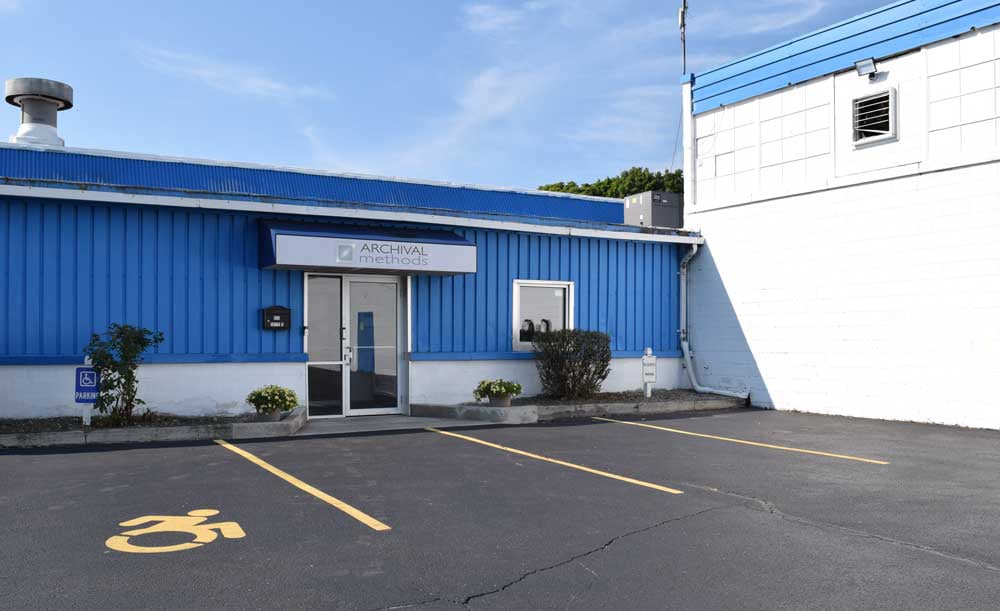
Welcome to Archival Methods! View of our front entrance at 655 Driving Park Blvd., Suite 5, Rochester, NY 14613. Locals and people passing through town can easily arrange free local pick-ups when placing their orders.

We are not a storefront, but our front office features a customer center. There’s a table for discussing your project and showing you examples of products. There’s a computer you can use to place your order online if you want to purchase something during your visit. Locals often order online from home and opt for free pick-up.
Warehouse

Three quarters of this aisle warehouses our line of Metal Edge Boxes – Drop Front, Short Top, Full Top, Hinged Lid, and Document Boxes. Most are available in tan, gray, or black and in a range of useful sizes. We make these in-house.

Our wide selection of archival Mat Board, Foamboard, and Papers are offered in many standard sizes. If you don’t see the size you need listed, order the next size up and we will cut it down for you (to one size) upon request.

We also sell many archivally safe enclosures and sleeves. They are useful for adding another layer of protection to photos, documents, books, objects, and other items in your collection that you are trying to protect and preserve.

Archival Binders and Binder Boxes are popular products that we manufacture. They’re great for “active” collections (ones you like to get out and look at). They provide a safe environment for your photos and documents and allow you to easily peruse the contents. We do our best to keep our shelves stocked for quick turnaround times but sometimes you might have to wait when they are in production. We appreciate your patience!
Shipping

Once your order is picked from the shelves it goes on one of these carts to be packed and shipped. Occasional damage during shipping is unavoidable. Our staff does an excellent job packing your items for safe transit, and our damage rate is very low. Many of our reviewers actually comment on the great packing job we do. We use paper, and cardboard that we recycle with a special shredder, to cushion your items inside the box. If we ever use plastic as filler, it is being re-used from something we received in from one of our vendors.

Wide view of our shipping department and orders being packaged. On the left are the pallets designated for the different shipping companies. When you check out, the last page has a drop down menu where you see shipping rates and pick your preference. We offer shipping with USPS, FedEx and UPS in ground and expedited options. Orders over $375 qualify for free ground shipping in the continental US (excludes PO boxes).
Manufacturing Department

This is our Polar cutter. All of our Board and Paper comes to us in large sheets which we cut down into the various sizes that we need. We also use it to cut down some raw materials for making other products. See the Polar cutter in action on YouTube.
Making a Metal Edge Box

These are all dies for creating the metal edge boxes. Every different size of metal edge box needs at least one die (hinged lid) but sometimes two (one for the top and one for the bottom).

Here is the die cutter in use. Barbara is about to place a piece of tan box board onto the metal surface. When she activates the machine the base moves up for the die to stamp out the shape of the box. This die is cutting out the base and lid for a 1-1/2″ Drop Front Box. See the entire process of making a metal edge box on YouTube.

Barbara placing the lid of the 1-1/2″ Drop Front Box on the stack. Once she is finished cutting out the quantity of boxes she needs, she will take them to another machine to put the metal edging on them.

This is our metal edging machine. The large clear reel on the back is the spool of metal edging material. It gets fed through the machine to the front where it is operated using a foot pedal. See the metal edger in action on YouTube.
Cad Cutter and Hand Assembly Area

This is our Kongsberg cad cutter that cuts most of our raw materials that we then hand assembled into portfolios and binders.

The buckram and Arlington bookcloth that we use to cover our boxes and binders comes on these large rolls to be cut on the Kongsberg cutter. See the cutting process on YouTube.

Once materials have been cut they are labeled and staged for assembly. Watch a sped up version of Josh making a binder slipcase on YouTube.

Here’s a stack of Museum Drop Front Boxes in the process of being made.

Here are the Museum Solander Cases in progress. The basswood forms durable sidewalls on this clamshell style box.

Sylvia is using the riveter to put 1-1/2″ O-Rings on gray metal edge Binder Boxes. We use the riveter to install the rings on all of our binders so this machine also gets a lot of use. See the process on YouTube.

Once the rings are installed these will go to Barbara to have the metal edging done. And voila, a Binder-in-Box is born!
Custom Mats

Our mat cutting area is also a busy place. Karen uses the Gunnar machine to cut Pre-cut Exhibition Mats, Mat & Presentation Kits, and Custom Mats. We only offer acid-free, lignin-fee, buffered 100% cotton museum board or conservation board.

She also hinges a lot of mats to backing boards in this area. Watch Karen and Gunnar in action on YouTube.
Front Office

Lastly, there are the folks in the front office who answer questions, troubleshoot problems, manage inventory, update the website, and do many other jobs to help keep things running smoothly and customers happy. Above is Angela at my desk when we took some new photos for the latest version of our Preservation Guide.
And this concludes our tour of Archival Methods! I hope you’ve enjoyed it. If you have questions or comments, contact us via phone or email.
