We are a small but knowledgeable team here at Archival Methods, and we do our best to answer everyone’s questions and concerns quickly and accurately. We interact daily with customers from around the world via phone and email.
People contact us with all sorts of questions regarding their archiving projects. It is a great way for us to learn. These conversations may lead us to update or clarify information on our website and even create new products.
This is our inaugural Customer Spotlight blog post, wherein we highlight a customer project that uses archival storage supplies. While many projects are similar in nature, there are many different ways to approach them.
Storing a Manuscript
In 2021 Eleanor Linn of Ann Arbor contacted us with some questions about preserving her recently completed manuscript and the vintage and contemporary photographs accompanying it.
“After 50 years, I am putting together a travel memoir about an overland trip I took across central Afghanistan before the Taliban or even the Russian occupation. I’ve digitized and enhanced my old prints and slides and it’s taken me 3 years to write the 34 chapters of text. Now I want to keep all the pieces together.” – Eleanor Linn (EL)
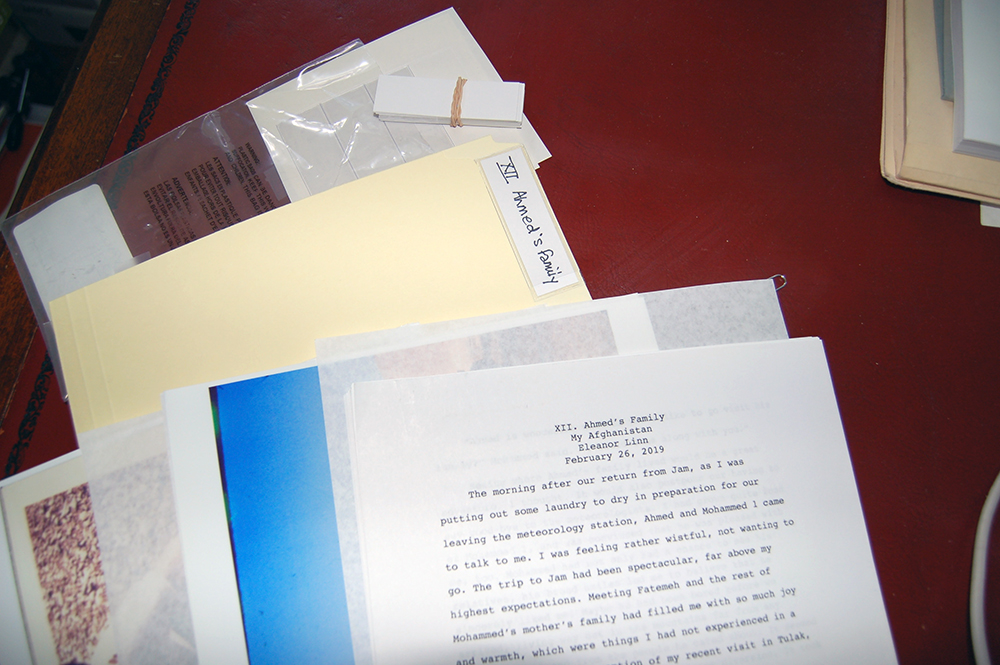
Upon completing the project, she wanted to find an archival storage solution. Eleanor’s plan for the manuscript and photos included metal edge boxes, interleaving paper, and file folders.
Time to Do the Math
She contacted us with questions about the cumulative thickness of our Archival Thin Paper (for interleaving) and Archival File Folders. She needed to figure out which metal edge box to order and how many she would need. This is a big challenge when facing an archiving project – what to order and how much you will need.
She measured the thickness of the manuscript chapters, and the stack of photographs, to be stored in archival file folders. The photos would be stored with interleaving between them. To calculate the depth of the boxes needed, Eleanor had to know how much space the folders and interleaving would take up.
“Thanks for measuring the interleaf paper, Jenn. I didn’t realize that it’s so thin – only 1/4″ for 100 sheets! I have 318 pages of text on 8 1/2 x 11 20 lb paper (500 sheets is 2 1/4″ high, so I imagine it will need 2″ of storage height) and 85 8 x 11 inkjet prints on HP heavy paper (50 sheets is 1 1/2″ high, so I imagine I’ll need almost 3″ depth for the photos). With the interleaf paper (85 sheets) and 34 file folders to separate chapters, I figure I’ll probably need 2 of your 5″ deep archival storage boxes. How deep is the box of archival file folders?” -EL
We recommended the Archival Thin Paper to interleave the digital prints. She ordered Side Loading Print Sleeves to protect the original 3-1/4 x 5 and 5 x 7 photos. Eleanor used Prismacolor Fine Line Archival Markers for labeling the file folders. She ordered two Full Top Metal Edge Boxes, size 10-½ x 12-½ x 5 to store everything together. The original manuscript chapters sorted into archival folders and all the photos.

What follows is Eleanor’s description of her project.
“In the summer of 1970, I was twenty-three years old, living in Paris, and married to a research mathematician. My father-in-law bought us a Toyota Land Cruiser and we embarked on an overland trip that was initially going to be to India. This was before the Islamic Revolution in Iran, and before the Soviet invasion, the Taliban or Al-Qaeda existed in Afghanistan. Many people in rural areas still practiced traditional Persian ways. They hardly had electricity or running water, no telephones or working postal system. Things were generally peaceful, and I had the good fortune to meet friendly and resilient people, who had a major impact on my life.“
“Now, fifty years later, I have written a memoir about my trip and have digitized and adjusted the printed photos and slides, which were badly faded. I also printed some related images from other sources, yielding almost 100 pages of 8 ½ x 11 digital prints.”
“Not wanting these materials to degrade any further, I bought some flat storage boxes from Archival Methods, archival file folders and labels for each chapter, interleaving thin paper to protect the recent digital photographs, and print sleeves for both the older photographs and a few paper objects.”
“I have circulated digital copies of this work to various friends and colleagues, and will also submit it to several Afghanistan historical archives. I may decide to print a paperback version of this work as well, but I have not yet decided on the details. In the meanwhile, I know that my basic materials will be safe.”

“Here is a photo from Ahmed’s village. That’s me in the jeans. The man in the white shirt was the meteorologist who invited me to go to the village. Ahmed was his servant at the meteorology station, who of course came along too. The other men in the picture lived in those tents. You can see a camel tied up next to the tent on the right. There are cattle in the background, which you can hardly see. Next to the tent on the left, you can see a tripod with a goat’s carcass mounted on it. One of the women poured cream from their cows into the goat’s carcass and shook it to make butter.”
“While I was there, the men caught fish in the river and the women fried them in the butter they had just made. They also baked fresh bread in an oven that was dug into the ground on the far side of one of the tents.”
– Eleanor Linn, Ann Arbor, MI 8/19/2021
Many thanks to Eleanor for sharing her story with us! Please contact us if you have used our archival supplies and want to be considered for a Customer Spotlight.
