How to... Properly Store your Negatives?
Negative storage is an essential part of storing and preserving one's collection. The negatives are important in the sense that they are the true originals of the photographs. Storing them safely and properly is needed to ensure they will be there when and if you ever need them. It is recommended to store negatives separately from the prints, not only to prevent interaction of chemicals within each but to have options if something were to happen (such as water damage, etc.) to be able to reproduce the print.
Storage options:
Paper enclosures
- Protect from light and buildup of gases and moisture inside the enclosure
- Less expensive and easier to label with a pencil than plastic enclosures
- Image cannot be viewed without removing it
- Should be chosen based on the passing of the PAT (Photographic Activity Test)
Plastic enclosures
- Allow for viewing of image without removing it
- Heat sealed on the edges to eliminate the use of adhesives
- Polyethylene
- Protects from dust, handling, pollution and moisture
- Smooth, non-rigid plastic with good clarity
- Cost effective and available in numerous sizes
- HD (High Density) Poly will have a slightly frosted appearance
- Polyester
- Also known by trademark names- Mylar, Melinex and Estar
- Hard, semi-rigid and has the highest optical clarity
- More chemically inert than other plastic enclosures
- Polypropylene
- Economical
- Excellent for slide storage
- Very similar chemically to polyethylene
Once they are individually placed in the sleeve, paper or plastic, the next step is to store them in an archival box. It is best to choose a box that will allow you to organize and categorize your negatives, so they can be easily found if needed. We have found that the metal edge hinged lid or short top boxes work best for storing negatives. They allow for the negatives to be stored horizontally and easily organized by labeled dividers. Many times storage options are offered as kits including the box, folders and/or sleeves and index cards.
Be sure to check below for other helpful hints in storing your negatives.
Create an archival quality "Scrapbook of Memories"
with our Accent Albums.
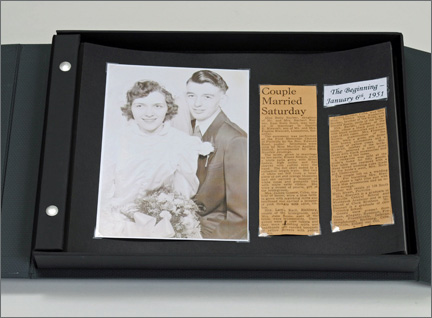
Accent Albums
Print organizers are another great gift idea. Everyone could use storage boxes to protect and preserve their 4 x 6 prints.
Issue #3 Tip: Proper Handling & Storage Locations for Negatives
- DO NOT TOUCH with bare hands. Wear cotton or nylon gloves and handle carefully. Most damage occurs during handling of negatives.
- Store no more than 3 strips per envelope or sleeve. This will aid in preventing damage from handling and viewing of negatives.
- Keep away from all forms of moisture. Humidity at any level can cause damage that cannot be undone.
- Store in archival sleeves (paper or plastic) and boxes. Storing them in old shoe boxes that contain acids will not protect them, but deteriorate them over time.
- Sunlight, like with photographs, should be avoided as well as extremely cold or hot temperatures such as unheated attics and garages. Wilting and/or cracking of negatives can be avoided by storing them in a controlled temperature location.
- Avoid long periods of light exposure is also a good idea. Light in large doses can cause the negatives to fade or alter the colors within the negative making any reproductions stray from the original photograph.
- Store negatives and prints separately!
Issue #3 Term: P.A.T. (Photographic Activity Test)
Used to determine the archival quality of various paper and plastics products intended for photographic storage. It is an accelerated aging test which uses a specialized photo-emulsion in contact with a paper sample. This test is taken at elevated temperatures and humidity levels to simulate the natural aging process.
Questions & Answers
We receive questions about archival practices, framing, custom mats, etc. and have decided to incorporate a questions and answers section in the newsletter.
If you have any questions, please feel free to e-mail them to [email protected] or visit us on Twitter, FaceBook or LinkedIn.
Q: What should I do with my old slides?
They've started to grow mold / fungus when put in plastic sleeves. The sleeves were archival, supposedly. I thinka box might have been a better solution. Do you have any suggestions?
A: This question about archival storage for 35mm slides requires an explanation that will touch on three areas;
1) Storage Environment
2) Temperature and Humidity
3)
Characteristics of plastics storage pages and when box storage should be used.
- Prolonged exposure to conditions above 60 % relative humidity can allow for fungus growth. This has nothing to do with what type of storage page or box that is used. High humidity can cause the gelatin emulsion on film to stick to plastic storage pages.
- Approved plastics for photographic storage are polypropylene, polyester and polyethylene (described above) all have slip agents applied to the surface to prevent sticking. If too much of this waxy additive is used it can appear on the surface as white spots that can be mistaken for mold.
- Storage area humidity should be between 30 - 50 % relative humidity.
- If visual access is required to identify slides or negatives plastic sleeves or pages is a good choice. They should also be stored in binders, boxes or file cabinets to safeguard the collection.
- Box storage is the best choice for slides and negatives to achieve the most compact storage conditions. Keep in mind you will need to develop a filing system in order to find specific images.
Happy Holidays from our families to yours! |

 RSS
RSS Translate


 Follow us on Twitter
 Become a fan
 Join us on Linked-In
 New RSS feed
 Forward to a Friend

