| Newsletter • Issue # 13 | To view this email as a web page, click here |
| If you haven't already, add [email protected] to your address book to assure delivery of requested newsletters. | |
 |
||||||||||||||||||||||
|
||||||||||||||||||||||
Dear *|TITLE:FNAME|*,Thank you for receiving the latest Archival Methods Newsletter. We hope you find the information useful. IN THIS ISSUE:
|
||||||||||||||||||||||
Connect |
 Follow us on Twitter Follow us on Twitter Become a fan Become a fan Join us on Linked-In Join us on Linked-In New RSS feed New RSS feed |
SHARE |
 Forward to a Friend Forward to a Friend |
Contact |
| Our Website: ArchivalMethods.com Email or call: 866-877-7050 |
RESOURCES |
|
> Archivery > Conservators > News Archive |
Articles |
| > Mounting Techniques > Family Photographs > Family Photo Storage |
NEWSLETTER ARCHIVE |
|
> Past Newsletters |
Some may consider the use of slides in photography to be archaic, given the amount of advances the field has seen over the years. While this is a somewhat understandable perspective, it's also not entirely true. In fact, slides are far from obsolete and can still be quite useful, due to their durability when properly maintained and their ability to easily be scanned and digitized.
For slides to remain of use to a photographer, the items will have to be handled and stored with all necessary delicacy and by using the most appropriate archival methods.
 |
Considerations for
storing slides
Slides have to be handled with care, and their composition requires that they be kept away from the same environmental hazards that would adversely affect standard photographic prints or negatives. The most significant of these are excessive sunlight, dust, humidity, heat and acidity.
Keeping those considerations in mind, the archival products that will be suitable for slide storage must adhere to a number of standards. When storing using plastic binder pages, the only forms of plastic acceptable are polyester, polyethylene or polypropylene. Pages made of or containing any polyvinyl chloride (PVC) must be avoided, due to that material's use of a plasticizer that forms hydrochloric acid when it breaks down.
If storing in boxes, wood shouldn't be used, or any materials containing varnish or shellac. An enclosure of this type made with a baked enamel finish on steel is optimal. Paper materials can also be used - provided they are conservation-grade, buffered, free of lignin and having a neutral or slightly basic pH - a number between 7 and 8 on the pH scale, for example.
Slide-appropriate storage products
Storing slides in a binder is one simple and convenient way to keep them organized and carefully protected. The Collector-grade ring binders would be appropriate, stocked with binder pages (which hold 20 slides apiece) made of heavy, archival-safe polypropylene, providing durability and protection from environmental hazards.
Additionally, the Binder-in-a-Box combines the organizational benefits of binder storage with an extra level of protection, due to its archival-safe boxboard and paper meeting the criteria of the Photographic Activity Test (PAT).
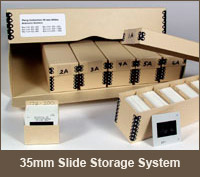
Finally, the 35mm slide storage system, made entirely from archival-grade boxboard, will be useful for collectors who need to hold a large number of slides. It comes with boxes that can hold either 200 cardboard-mounted slides or 100 glass-mounted slides, as well as eight trays that hold up to 25 cardboard-mounted slides. All of these separate enclosures are kept within a drop-front box that, all told, can hold as many as 1,200 cardboard-mounted or 600 glass-mounted slides.
Brafton written article for www.archivalmethods.com 3/23/12
Aluminum frames are assembled using hardware components sold in a kit or in bulk. Additional products are available to ensure the frame is hung securely on the wall.
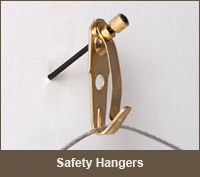 |
Safety hangers are simple to use. They will help defer the theft of one's frame piece (especially in public places) or from falling off the wall during a small earthquake or should bump. The hangers are brass plated with a knurled head steel nail. The spring loaded clip traps the hanging wire in a closed loop preventing it from upward motion. Use two hangers for heavier frames or when keeping frames level is a must.
Another accessory many turn to is the Frame Lock Security Hanger System. It is designed for metal frames and provides a quick and easy way to secure frames to walls. Additionally, it makes the task of hanging multiple frames level and keeping them evenly spaced simpler to tackle. The low-profile bracket attaches to the wall with plastic hangers and screws. The top rail of the frame will hang from this aluminum cleat. T-Head screw is positioned on the bottom rail and also is anchored into the wall. Use the security wrench (sold separately) to lock frame in place. Frame Lock will work on all profiles of aluminum section frames with a universal channel on the back side; will not work with back loading frame styles.
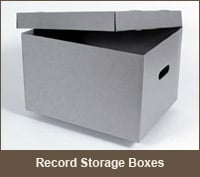 |
This is a reference to corrugated board used to make boxes. The Double Wall refers to the process of using two layers of fluted corrugated board for additional strength and rigidness while minimizing excessive weight of the box. The Double Bottom Record Storage box (item # 55-2522) is an example of this design.
Q: I need interleaving paper to protect my inkjet prints from scratches. What type do you recommend?
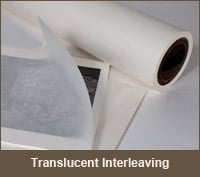 |
A:There are several options for interleaving ink jet prints. We would recommend a glassine, which is the smoothest option available. Our Translucent Interleaving sheets are archival grade glassine. They are recommended for use with prints, etchings, watercolor, drawings and ink jet prints (as long as there is not a gelatin protective layer). The glassine is not a suggested material use for interleaving of black and white silver gelatin or traditional color photographic prints.
Another option that is becoming more popular is Polyester Film. This item is available in a 40" x 50' roll as well as pre-cut sizes. It is an inert material that will not discolor or damage artwork or prints. It is highly recommended for ink jet prints since they are vulnerable to scuffing
If you have any questions, please feel free to e-mail them to [email protected] or visit us on Twitter, FaceBook or LinkedIn.
 RSS
RSS Translate


