How to... Protect Your Books
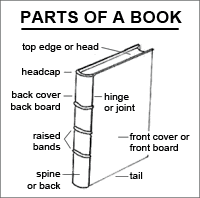
The steps to caring for your books can be broken down into five categories; environmental conditions, shelving, storage, handling & use, and cleaning & maintenance. Not all books are created equal. Some are more durable than others and some are more vulnerable to certain elements. The potential problems that may occur over time to book collections can be eliminated by taking the preventive precautions below.
| ENVIRONMENTAL CONDITIONS |
SHELVING |
STORAGE |
HANDLING & USE |
CLEANING &
MAINTENANCE |
| DO NOT expose to large amounts of light |
DO store books vertically |
DO store in archival, acid-free boxes (alkaline corrugated cardboard) |
DO NOT pull by head cap, grab the spine when removing off of shelf |
DO Clean regularly to eliminate dust as well as monitor condition |
| DO NOT expose to rapid changes in temperature & humidity |
DO support with bookends or additional books |
DO NOT store in attics, basements or garages |
DO NOT place flat on table – it will cause stress to spine |
DO dust away from the headcap toward the edge with clean cloth or soft brush |
| DO place bookshelves away from wall |
DO store over-sized books horizontally – stacked no more than 3 high |
DO NOT store where flooding can occur (below a bathroom or main water pipe) |
DO NOT place face down on flat surface (open no more than 90 degrees) |
DO clean tough dirt with a white plastic drafting eraser |
| DO keep away from sources of heat (fireplace, furnace) |
DO NOT push to back of shelf and place about an 1” from the edge (the space will allow for notice of dust and insects) |
DO Watch for pests such as mice, rats, silverfish, etc. They are attracted to book materials |
DO use pencil not ink & paper bookmarks. Avoid paper clips, post-its & eating and drinking near book(s) |
DO NOT Dress books as this can cause stains and stickiness Consult a conservator to dress them |
TRANS-PORT SHIPPING CASE
Protect your prints and artwork!

Tip: Protect your Artwork and Photographic Prints from Harmful UV Rays
Natural and artificial sources of light can and do contain damaging UV light rays. It is not only sunlight that one should be concerned with when displaying photographs or pieces of art. Guidelines to protect against harmful light sources are below.
- Use UV Filtering glass or acrylite such as OP-3.
- Choose softer lighting that will not reflect into the glass of the framed piece
- Consider adding lights on either side of the frame to prevent direct light on artwork or print
- Avoid direct sunlight. Even if the glass or acrylite blocks UV rays the heat from the sun over the years can cause damage.
- Use incandescent bulbs. They have a much lower concentration of UV Rays.
- Avoid fluorescent lights.
*Once damage from UV light occurs, the damage (fading, yellowing, brittleness, etc.) cannot be reversed.
Term: ISO – International Organization for Standardization
International Organization for Standardization publishes international specifications, test methods and best practices for a variety of industries’ products & processes. The organization is based in Geneva, Switzerland.
Questions & Answers
If you have any questions, please feel free to e-mail them to [email protected] or visit us on Twitter, FaceBook or LinkedIn.
Q: I have recently purchased my first signed and would like to frame it. I do not know what to look for in the way of matting and backing. I want to get the right material to preserve the print correctly and have been told to mat and frame it using “Museum Quality”. Where do I begin, what is the proper material to use?
A: “Museum Quality” is not a specific specification but refers to using the correct materials for the artwork in question. The selection of 100% cotton mat board, also called rag board is a good choice for paper art work. A mat (in reference to framing) usually consists of two mat boards; one with a window opening and the other as a backing board that the print is attached to. They are hinged together either on the long or short side. When framing the artwork the glass or plastic should filter out UV light to protect the print from fading. You should also add structural backing to the frame such as a foam board, be sure it is acid-free. Attaching the paper artwork to the backing should be completely and easily reversible without damaging the paper artwork. The use of mounting corners is a good starting point.
The following links will take you to some product pages on our web-site:
Also, Complete Frame Kits are available for standard sizes. |

 RSS
RSS Translate


 Follow us on Twitter
 Become a fan
 Join us on Linked-In
 New RSS feed
 Forward to a Friend


